
Connections: An Exhibition of Collaborative Design
Indiana University Lilly Library
April 10 - May 6, 2006
MFA Thesis, Nathan Walton
This online exhibit comes directly from an exhibition held at the Indiana University Lilly library in April and May 2006. It was the graphic design MFA thesis for Nathan Walton, a student in the IU School of Fine Arts.
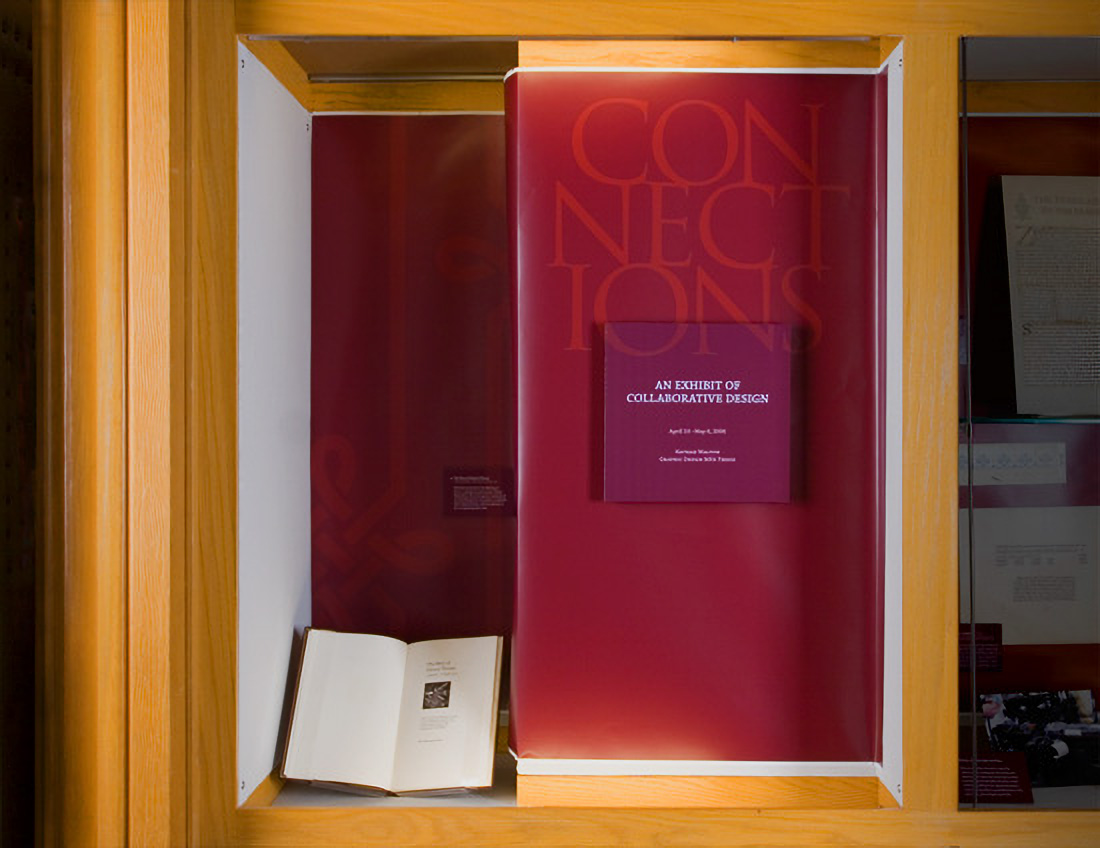
Introduction
The Diary of Edward Thomas
Illustrated by Hellmuth Weissenborn
The diary of Edward Thomas was printed in 1977. It has Edward Thomas' entries from the year 1917. At that time, he was an English artillery officer in World War I. The illustrator for the book was Helmuth Weissenborn, a German wood engraver who often illustrated books for the Whittington press. Weissenborn had also fought in World War I, but on the other side — the German side. As he read the diary, he realized that he had been stationed in some of the same areas and even fought in some of the same battles where Edward Thomas had been. What was even more incredible, he had kept sketches of his experiences, so Weissenborn was able to illustrate the book using drawings that he had made 60 years earlier — at the same time Edward Thomas was writing his diary. These two didn’t work directly together, but you could certainly look at this book as a collaborative effort between them. This is just one example of the kinds of books I’ve tried to include here: beautiful, well designed books that have required the talents of many people to make them.
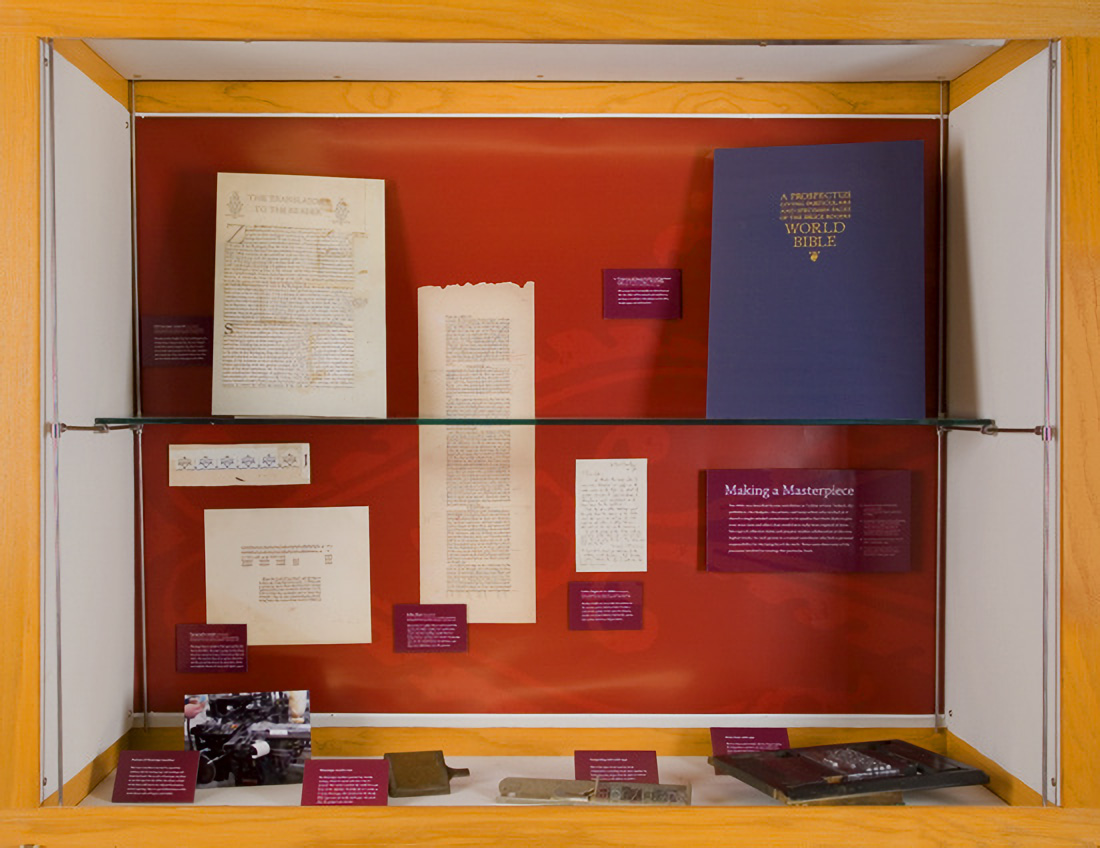
Design and Planning
Full-size composite of translator page (Facsimile)
Typographic Sample (Facsimile)
Galley Sheet (Facsimile)
Letter from Bruce Rogers to A. Colish (Facsimile)
Prospectus for the Bruce Rogers World Bible
In this case are items documenting the design and planning of the Bruce Rogers World Bible. Rogers was the designer who orchestrated the collaborative efforts of everyone on the project, and he was meticulous about everything. He chose the top professionals in each field to work on the monumental Bible, such as Frederick Goudy for the type design and A. Colish for the printing. Each contributor brought a particular expertise to give The Bible the highest quality in every detail.
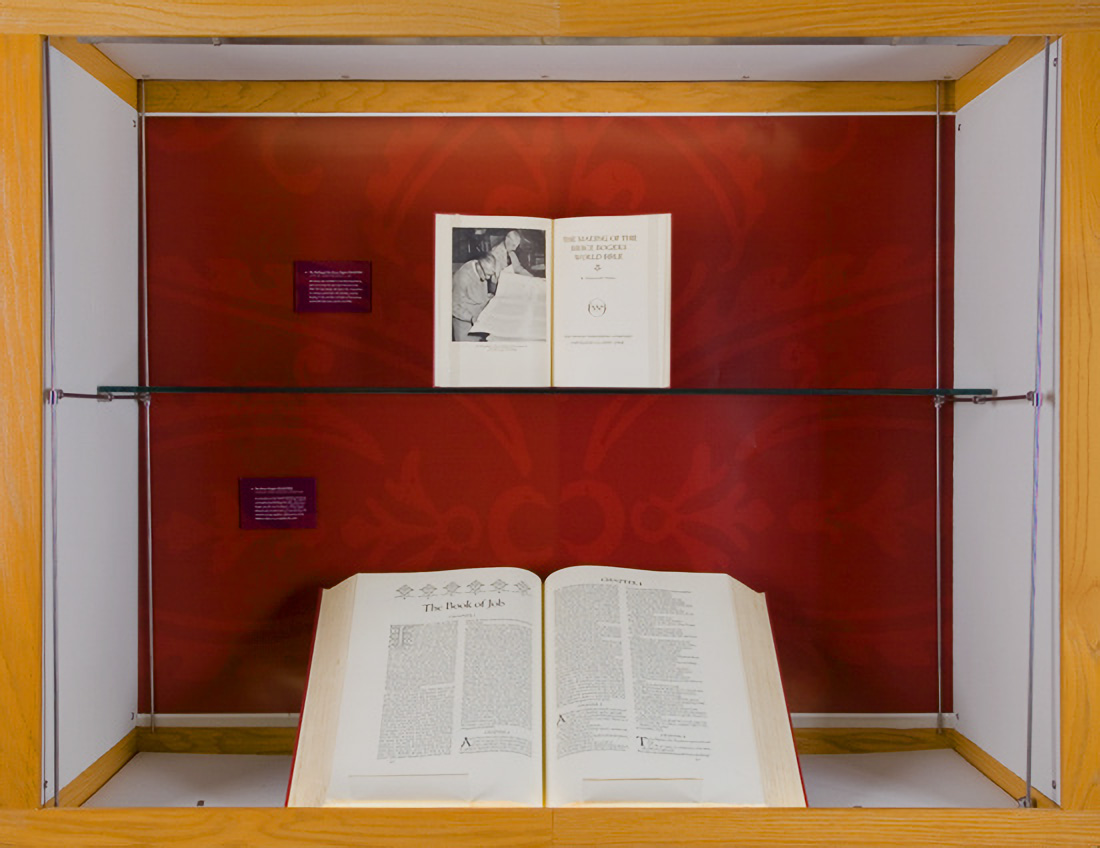
Making a Masterpiece
The Bruce Rogers World Bible
The Making of the Bruce Rogers World Bible
The Bruce Rogers World Bible was described by one contributor as “a labor of love.” Indeed, the publishers, the designer, the printer, and many others who worked on it shared a single-minded commitment to its quality, and each went well beyond the time and effort that would have typically been required of them. This type of collective vision and purpose enables collaboration at the very highest levels, for each person becomes a trusted contributor who feels a personal responsibility for the integrity of the work.
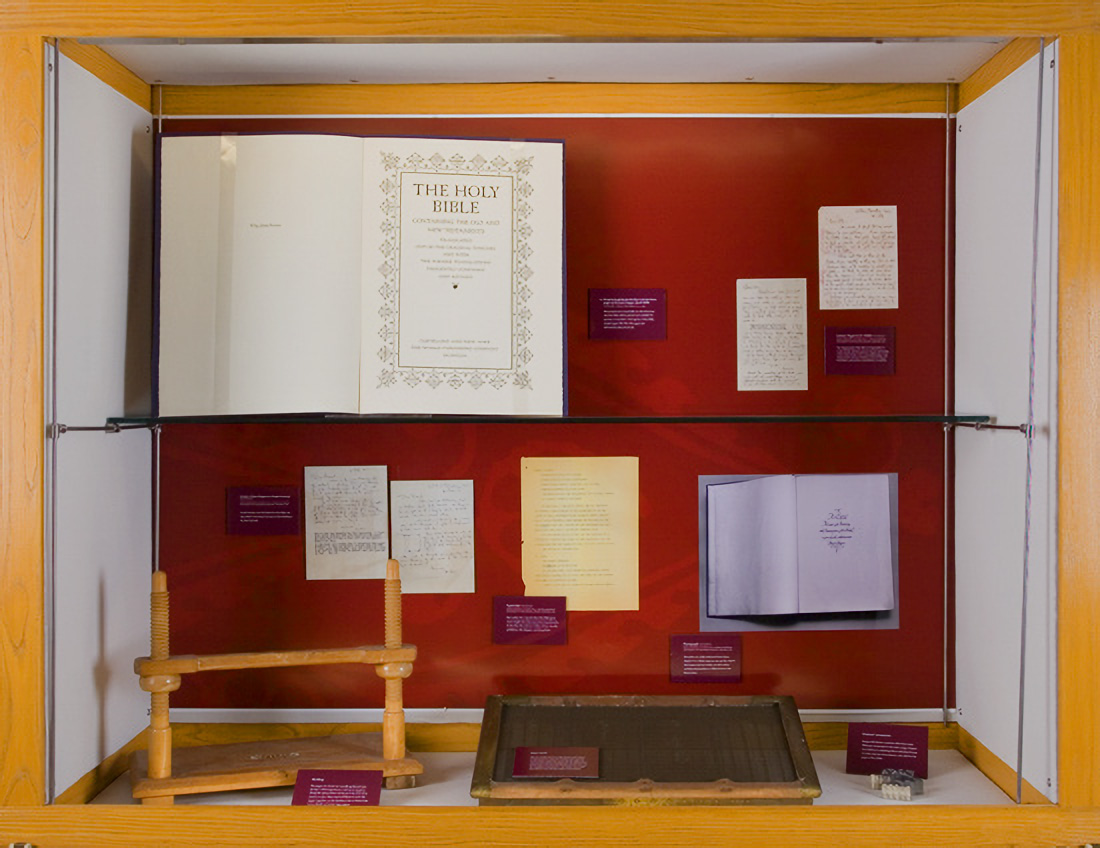
Printing and Finishing
Prospectus for the Bruce Rogers World Bible
Letters from Rogers to A. Colish (Facsimiles)
Letters from Rogers to Frank Fortney (Facsimiles)
Typescript (Facsimile)
Photograph (Facsimile)
As in everything else, the materials and construction of the Bruce Rogers World Bible are of the best quality. The paper was made specially by the Worthy Paper Association. Over 25 varieties of paper with varying finishes and colors were tested before one was settled on. It contains a watermark with the initials B.R. and A.C. for Bruce Rogers and A. Colish, the designer and printer. Binding was done by the Russell Rudder company, where they had to rebuild one of their sewing machines to accommodate the large book.
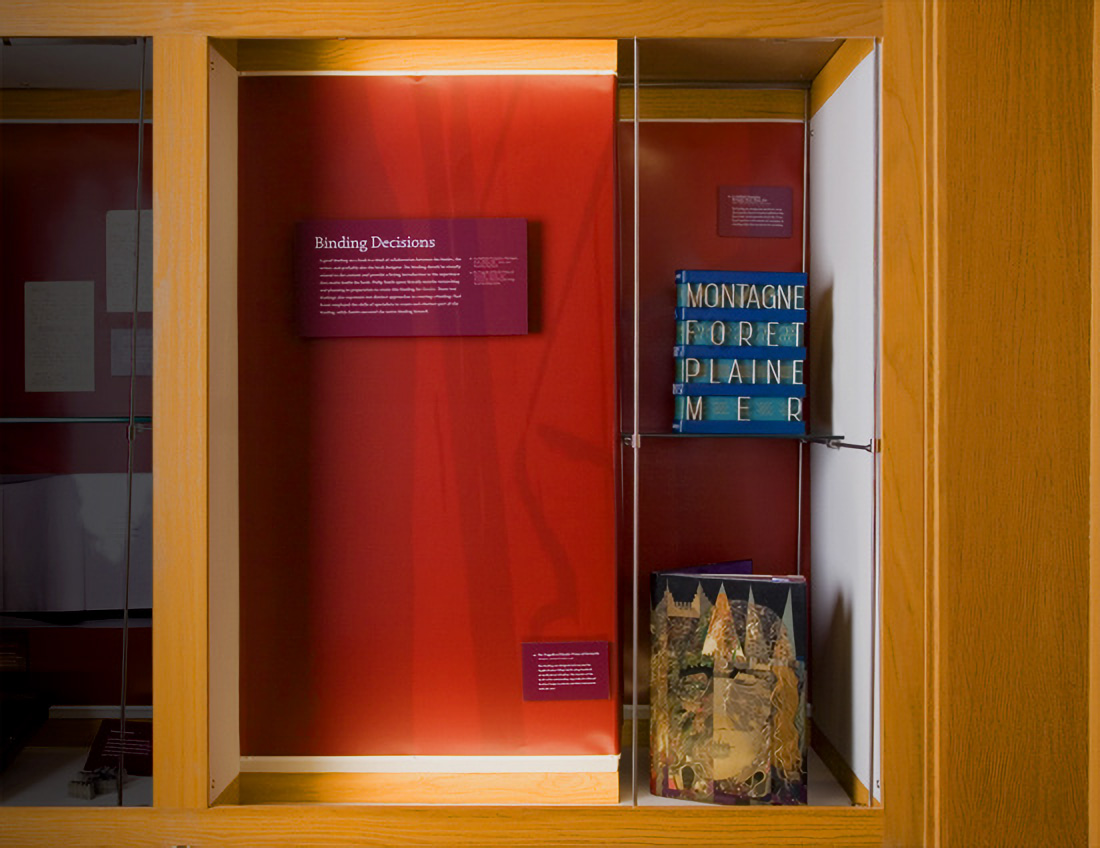
Binding Decisions
Les Ballades Françaises: Montagne, Forêt, Plaine, Mer
Bound by Paul Bonet.
The Tragedie of Hamlet Prince of Denmarke
Woodcuts by Edward Gordon Craig; this copy specially bound by Philip Smith.
A good binding on a book is a kind of collaboration between the binder, the writer, and the book designer. The binding should be visually related to the content and provide a fitting introduction to the experience that awaits inside. Philip Smith spent literally months researching and planning to create this binding for Hamlet. These two bindings also represent two distinct approaches to creating a binding. Paul Bonet, above, employed the skills of specialists to create each distinct part of the binding, while Smith executed the entire binding himself, using thousands of tiny pieces of leather.
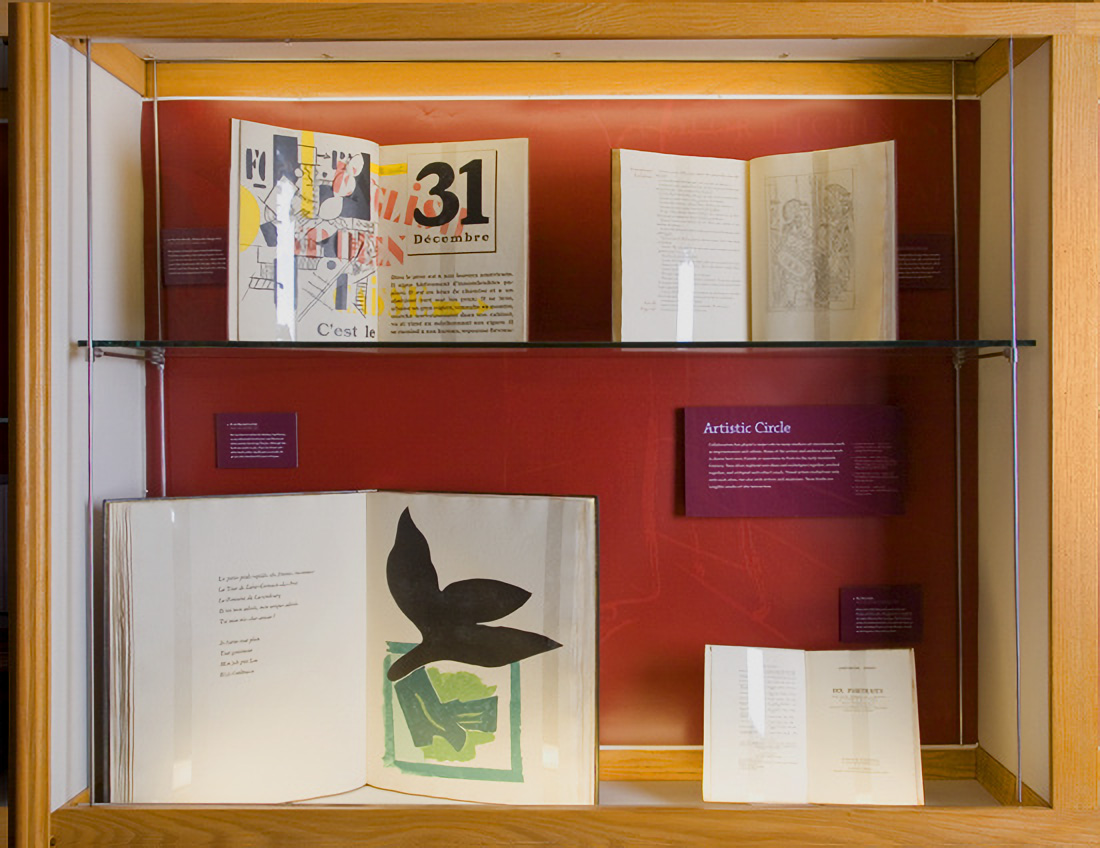
Artistic Circle
La Fin Du Monde
By Blaise Cendrars, with stenciled designs by Fernand Léger.
Lysistrata
By Aristophanes, translated by Gilbert Seldes. Designed by George Macy, with illustrations by Pablo Picasso.
Si Je Mourais La-bas
By Guillame Apollinaire, with woodcuts by George Braque.
Dix Portraits
By Gertrude Stein, with illustrations by various artists.
Collaboration has been important to many modern art movements like Impressionism and Cubism. The artists and authors whose work is shown here were friends or associates in Paris in the early 20th century. These include painters like Pablo Picasso, George Braque and Fernande Leger, and authors like Guillome Appolinaire, Blaise Sandraris and Gertrude Stein. These individuals often explored new ideas and techniques together, worked on collaborative projects, and critiqued each other's work. Visual artists worked not only with each other, but also with writers and musicians. These books are tangible results of this rich interaction.
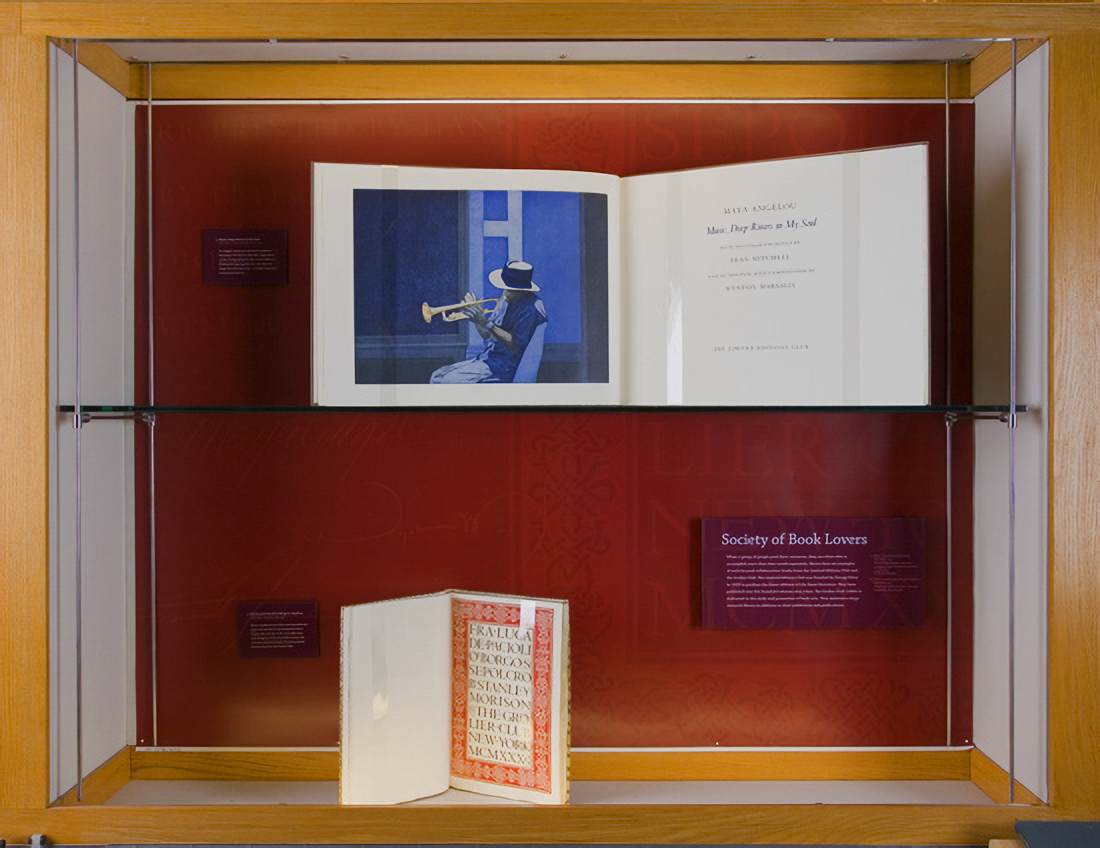
Society of Book Lovers
Music, Deep Rivers In My Soul
Poem by Maya Angelou, with color etchings by Dean Mitchell and musical compositions by Wynton Marsalis.
Fra Luca de Pacioli of Borgo S. Sepulcro
Written by Stanley Morison; title page designed by Bruce Rogers.
When a group of people pool their resources, they're often able to accomplish much more than they could separately. Shown here are examples of such group collaboration in books from the Limited Editions Club and the Grolier club. The Limited Editions Club was founded in 1929 to produce the finest editions of the finest literature in the world. The group has published over five hundred volumes since then. The Grolier Club, founded in 1884, is dedicated to the study and promotion of book arts. They maintain a large research library in addition to their exhibitions and publications. Music, Deep Rivers In My Soul, shown above, was published by the Limited Editions club in 2003. It contains poetry by Maya Angelou, etchings by artist Dean Mitchell, and a CD with accompanying jazz compositions by Wynton Marsalis. Fra Luca de Pacioli, below, was written by Stanley Morrison and has what is regarded as one of the most beautiful title pages ever designed. It was designed by Bruce Rogers.
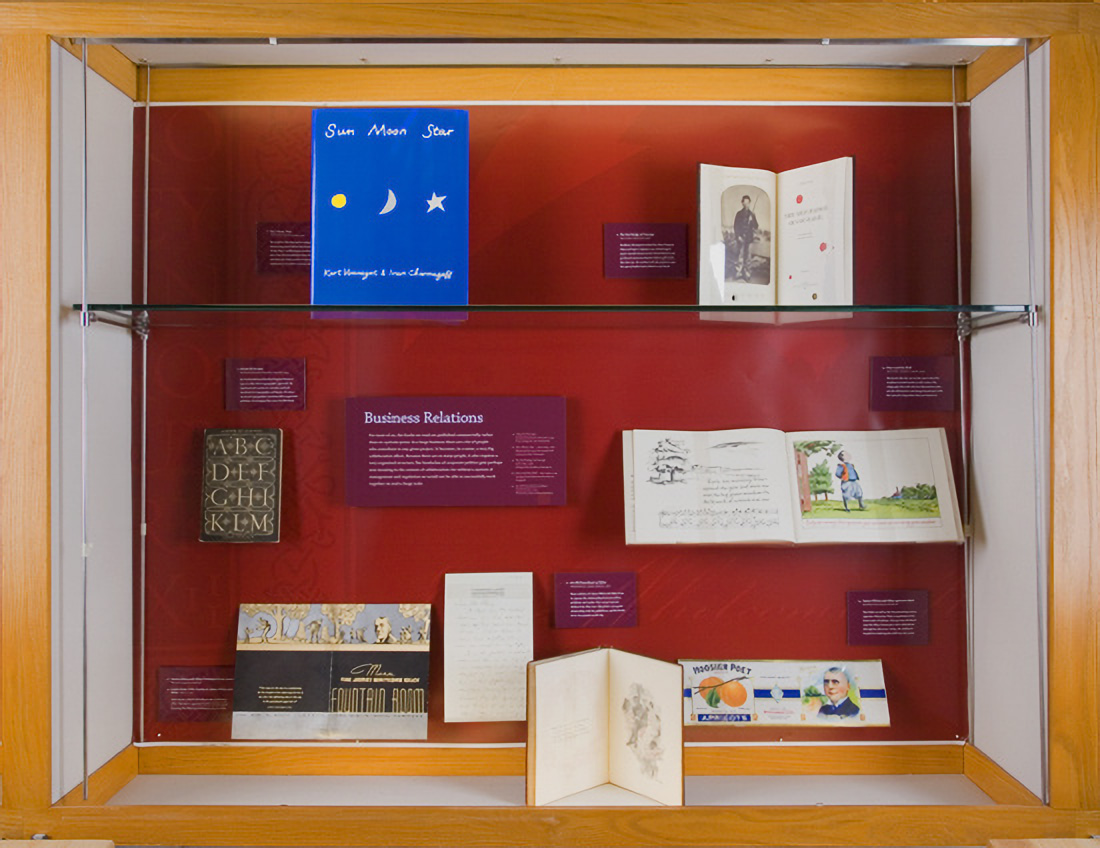
Business Relations
Sun, Moon, Star
Illustrated by Ivan Chermayeff and written by Kurt Vonnegut.
The Red Badge of Courage
Designed by Bradbury Thompson.
A Book Of Scripts
Cover design by Jan Tschichold.
Peter and the Wolf
Designed and illustrated by Warren Chappell.
An Old Sweetheart of Mine
Written by James Whitcomb Riley; illustrated by Howard Chandler Christy.
For most of us, the books we Read are published commercially rather than in a private press. In a large publishing business there are a lot of people who contribute to any given project, and it becomes a very big collaborative effort. it also requires a very organized structure. The headaches of corporate politics gain perhaps new meaning in the context of collaboration. Without a system of management and regulation, we wouldn't be able to successfully work together on such a large scale. The books here also highlight the important relationships between author, publisher, and reader. All three are essential to the success of a book.
Fruitful Partnerships
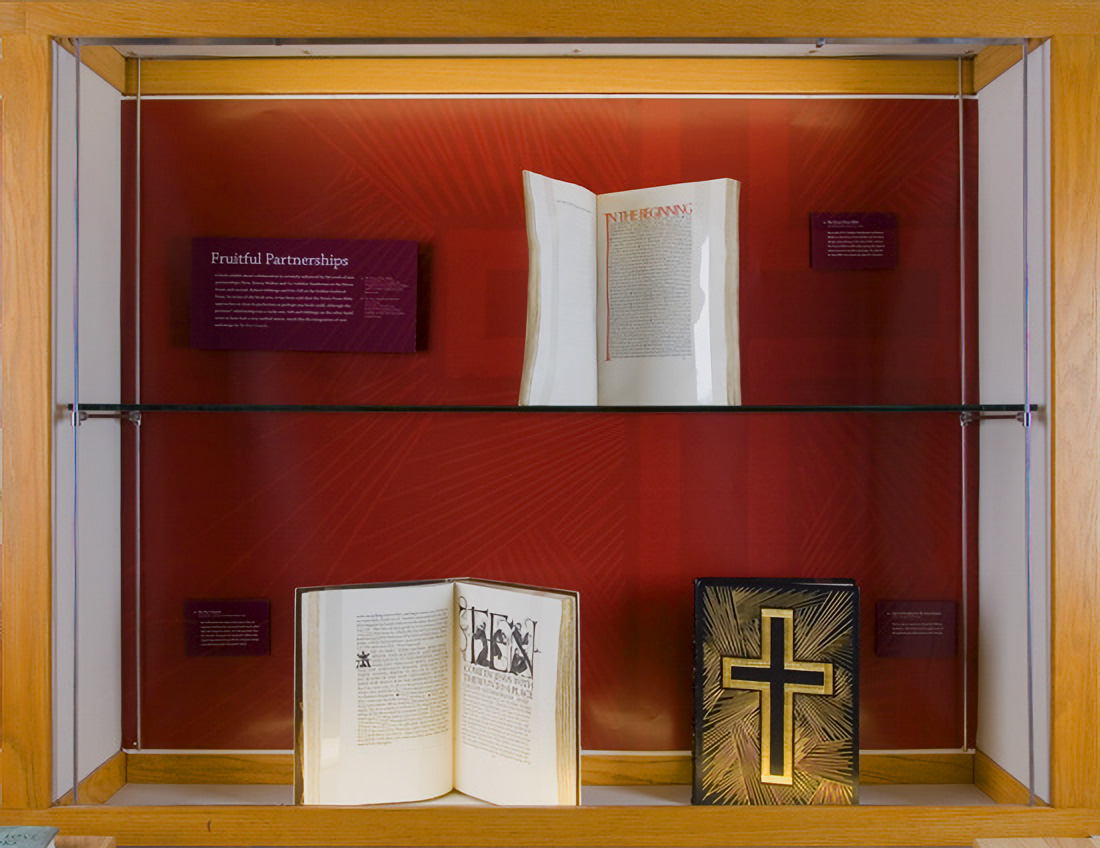
The Doves Press Bible
Designed and printed by Emery Walker and T. J. Cobden-Sanderson at the Doves Press.
The Four Gospels of the Lord Jesus Christ
Designed and printed by Robert Gibbings and Eric Gill at the Golden Cockerel Press.
Special Binding for The Four Gospels
Bound by William Matthews.
A book exhibit about collaboration is certainly enhanced by the work of two partnerships: first, Emery Walker and Thomas J. Cobden-Sanderson at the doves press, and second, Robert Gibbings and Eric Gill at the Golden Cockerel Press. In terms of the book arts, it has been said that the Doves Press Bible (above) approaches as close to perfection as perhaps any book could. Although the partners' relationship was a rocky one, Gill and Gibbings, on the other hand, seem to have had a very unified vision, much like the integration of text and image in The Four Gospels.
Expert Collaborator
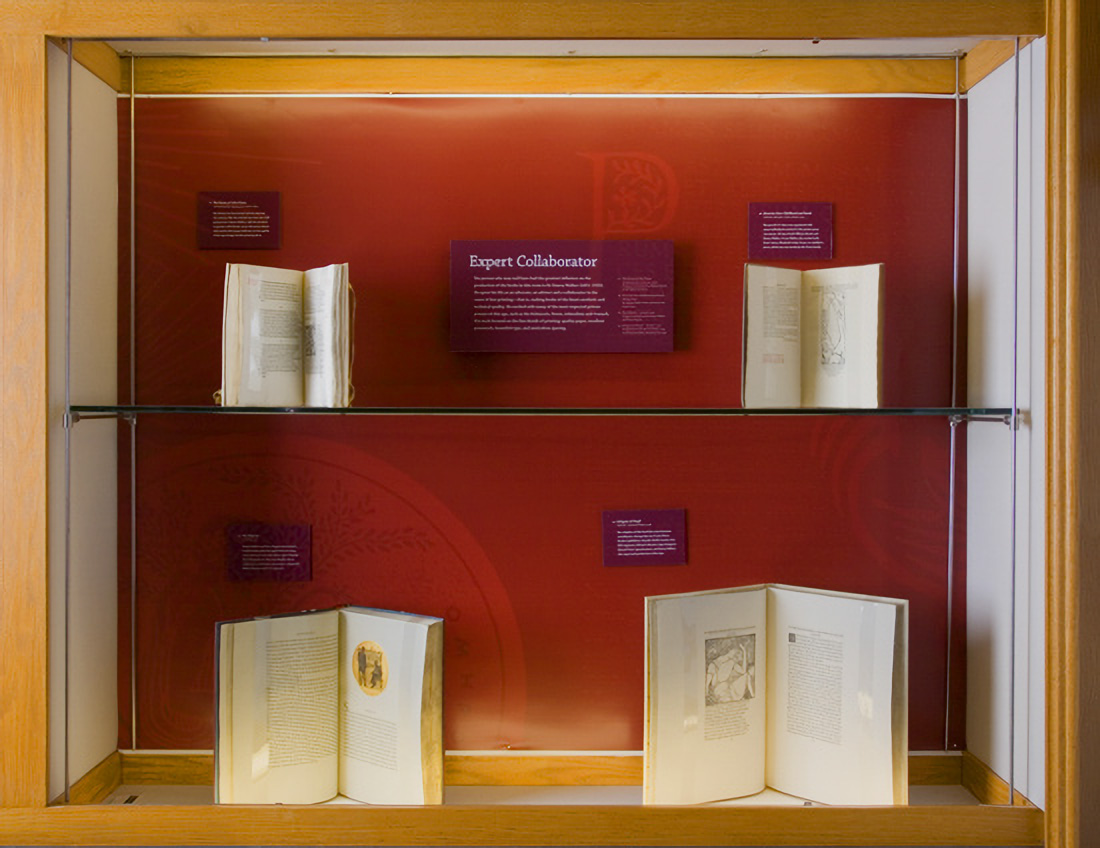
The Poems of John Keats
Designed and printed by William Morris at the Kelmscott Press.
Reveries Over Childhood and Youth
By William Butler Yeats, printed at the Cuala Press.
The Odyssey
Designed and printed by Emery Walker and Bruce Rogers.
Eclogues of Vergil
Designed by Count Harry Kessler, with woodcuts by Maillol, initials by Eric Gill.
The person who may have had the greatest influence on the production of the books in this room is Sir Emery Walker, who lived from 1851 to 1933 he spent his life as an advocate, advisor, and collaborator in the cause of fine printing — that is, making books of the finest aesthetic and technical quality. He worked with many of the most respected private presses of the modern age, such as the Kelmscott, Doves, Ashenden and Cranach presses. His work focused on the fine details of printing, quality paper, excellent press work, beautiful type, and meticulous spacing.
Past, Present, Future
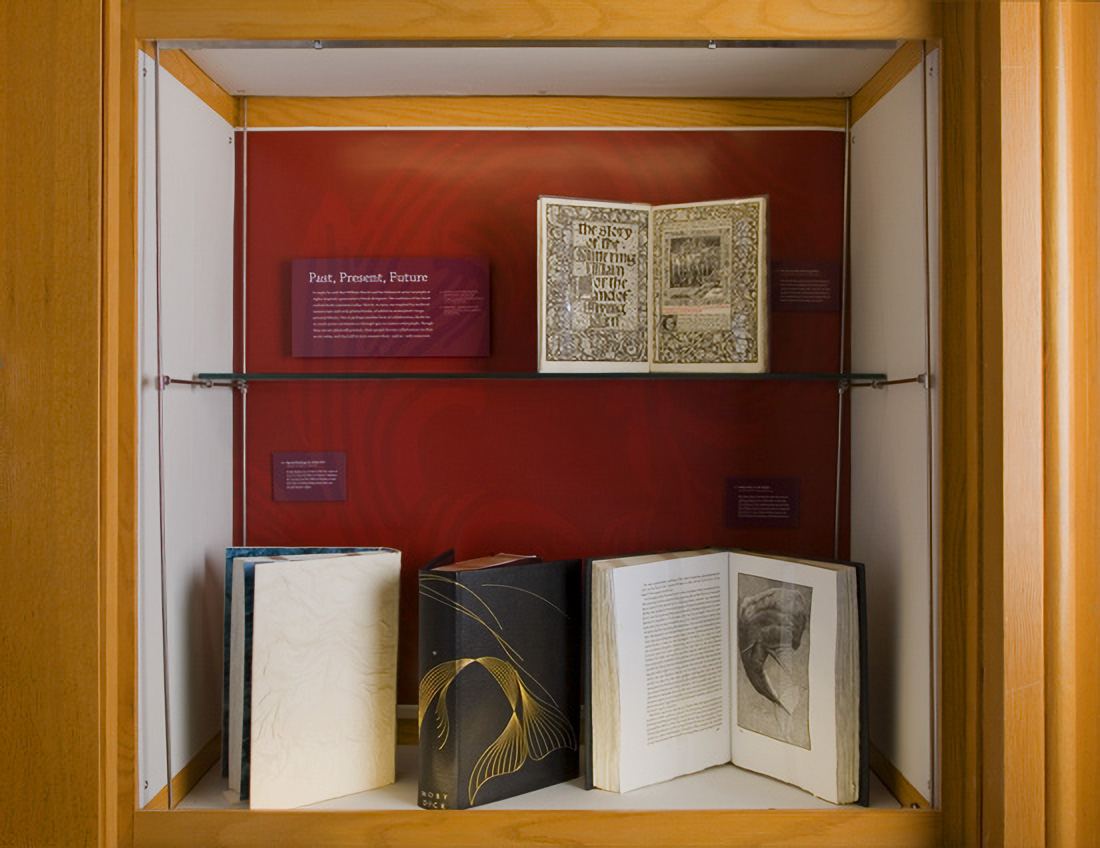
The Story of the Glittering Plain
Designed and printed by William Morris at the Kelmscott Press.
Moby Dick, or, The Whale
Illustrated by Barry Moser, printed at the Arion Press.
Special Bindings for Moby-Dick
Bound by Philip Smith (left) and Donald Glaister (center).
One could easily say that William Morris and his Kelmscott press inspired a generation of book designers. It was in part seeing Kelmscott books that moved Bruce Rogers to become a book designer. William Morris, in turn, was most inspired by medieval manuscripts and early printed books. This sort of indirect influence is certainly another important form of collaboration. We are inspired and influenced by someone's work, and though we may never meet them in person, they become valuable collaborators in what we do today, which could easily influence someone else in the future.
Cases and Stands
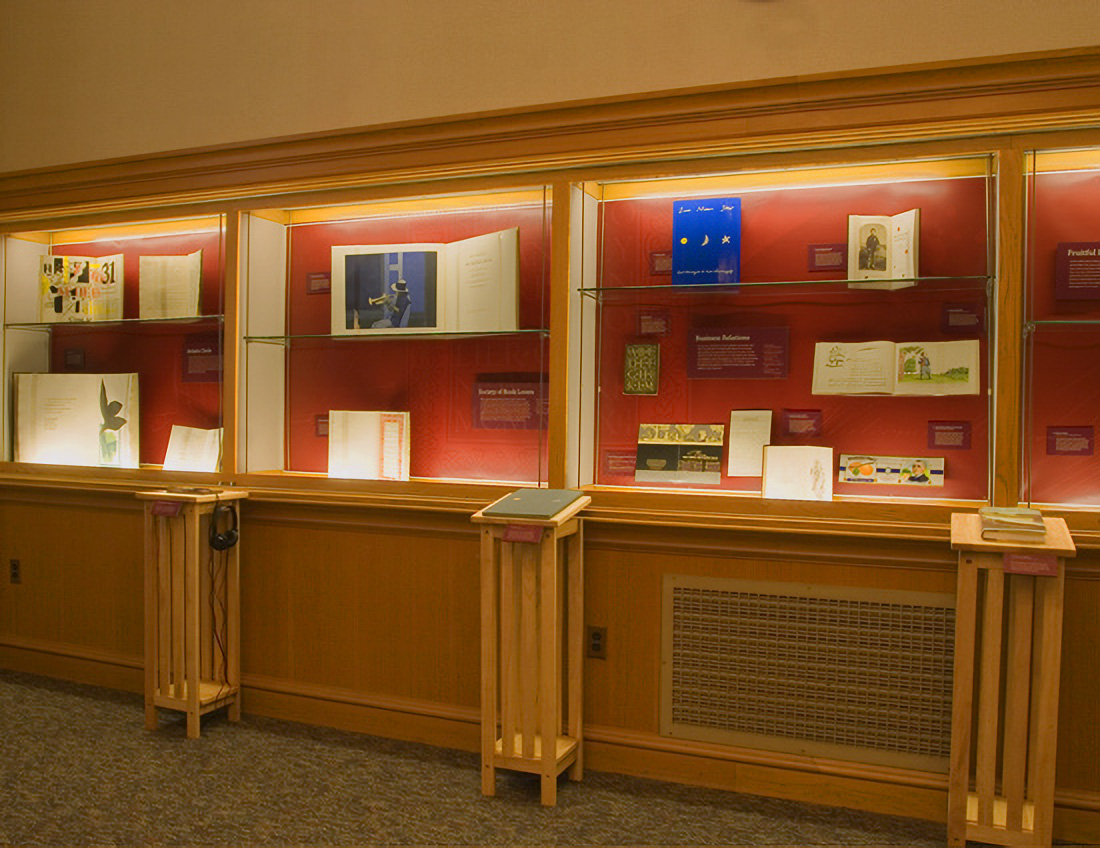
View of Exhibit
The stands in this exhibit held audio tracks or books that related to what was in the cases. It was a good way to make the show more immediate and accesible to visitors.